Allurion Gastric Balloon vs GLP-1: A Fair Comparison
What the FDA approved, how the temporary balloon works, what the US study found, and why its results cannot be ranked against GLP-1 medication trials.
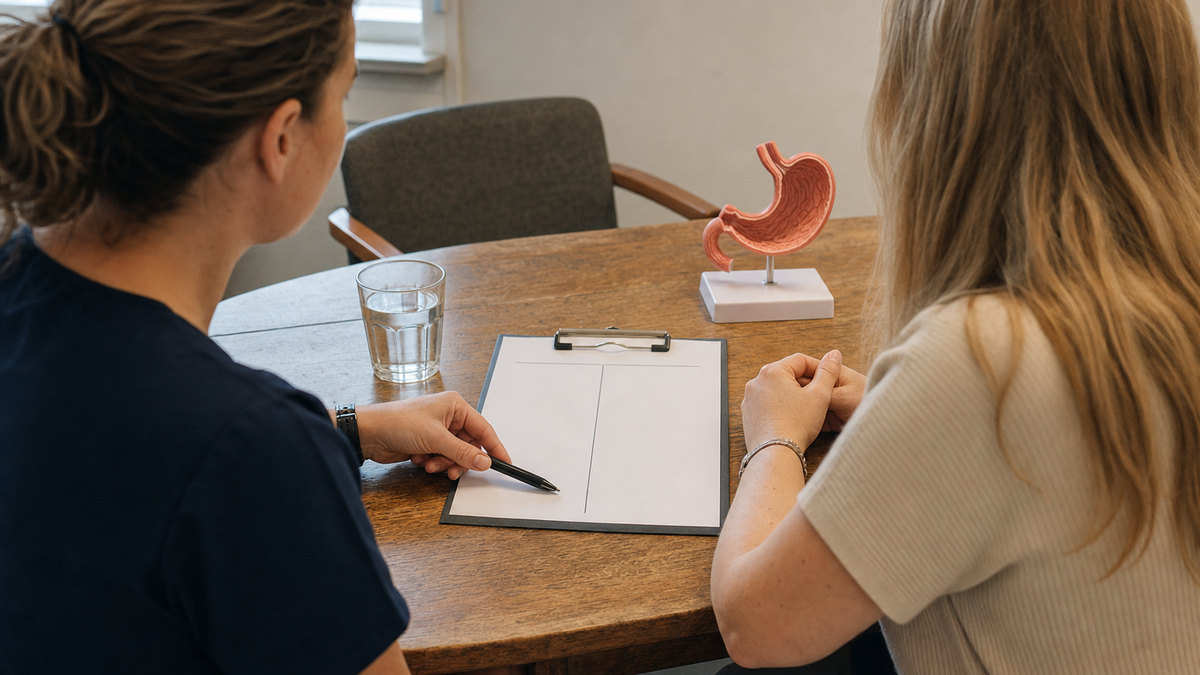
Allurion and GLP-1 treatment are different tools, and no head-to-head trial proves that one is better. Allurion is an FDA-approved temporary gastric balloon for a narrowly defined group of adults. GLP-1 medicines are prescription drugs used for long-term weight management in eligible patients. The useful comparison is how they work, whom they fit, and what risks each asks a patient to accept.
What exactly did the FDA approve?
The FDA approval record is specific. Allurion is indicated to promote short-term limited weight loss in adults ages 22 through 65 with a body mass index from 30 through 40 kg/m2 who have had at least one unsuccessful attempt at a weight loss program. It must be used with a moderate-intensity lifestyle modification program. The approved system allows up to two balloons during a 10-month period, and each balloon stayed in the stomach for an observed average of 15.3 weeks.
Those boundaries matter. This is not an approval for every adult who wants to lose weight, for a BMI below 30 or above 40, or for long-term weight maintenance. The device is restricted to prescription use, and the FDA approval letter requires practitioners to have specified training or experience.
How does a swallowed gastric balloon work?
The empty polyurethane balloon is folded inside a capsule. A patient swallows it while a catheter remains outside the mouth. Before any filling occurs, a clinician confirms that the capsule is in the stomach with x-ray or fluoroscopy. The balloon is then filled with about 550 mL of fluid. It takes up space in the stomach, promotes fullness, and reduces food consumption.
Ready to start?
$199 Skeptics' Trial, see if it works for you
One-time $199 trial with physician evaluation and, only if a prescription is approved and the dispensing pharmacy can fulfill it for the patient's location, one month of compounded semaglutide; the pharmacy confirms packaging and shipping details before fulfillment. No long-term commitment. Standard care starts with a $119 physician review; medication is separate, and compounded semaglutide programs start at $166/month.
Start the 30-day trialAfter roughly 16 weeks, the valve is designed to open on its own. The balloon empties, moves through the digestive tract, and is excreted. That is the intended course, but some devices may not follow it without a problem. The complete workflow and device design appear in the FDA safety and effectiveness summary.
What did the US randomized study find?
The AUDACITY study randomized 550 adults at 17 US sites to either Allurion plus lifestyle treatment or lifestyle treatment alone. The main effectiveness analysis included 524 participants, 261 in the balloon group and 263 in the control group. In the prespecified modified intention-to-treat analysis with multiple imputation, 58.0% of balloon recipients had lost at least 5% of body weight by week 48. In a separate exploratory responder analysis, 32.1% had lost at least 10%.
With last-observation-carried-forward imputation, mean total body weight loss at week 48 was 6.87% with Allurion plus lifestyle treatment and 3.09% with lifestyle treatment alone, a difference of 3.77 percentage points (95% CI 2.69 to 4.86). In the mixed-model analysis, the difference was 3.05 points (95% CI 2.09 to 4.00). Neither analysis met the full prespecified 3.0-point superiority margin for the second co-primary endpoint, although the FDA considered the difference clinically meaningful. That detail belongs beside the headline result because it shows both benefit and uncertainty. The study also excluded people unable to walk 400 meters without an assistive device, so its outcomes should not be generalized to the broad population with limited mobility.
The FDA also required a post-approval study of up to 250 treated patients to continue evaluating safety and effectiveness with two sequential balloons. Approval is real, and follow-up evidence is still being collected.
How common were side effects?
Stomach and intestinal symptoms were common in the 264 treated participants in the safety population. Gastrointestinal disorders were reported in 98.5%, nausea in 95.8%, abdominal pain in 77.3%, vomiting in 53.8%, and retching in 36.7%. Most events were mild or moderate, and the FDA summary explains that nausea and vomiting often clustered in the first few days while the stomach adjusted.
Serious events still occurred. Eight participants, or 3.0%, experienced 15 device-related serious adverse events, all after balloon number two. These included severe nausea or vomiting, gastric obstruction, ulcer, bleeding, acute kidney injury, and one gastric perforation with peritonitis. There were no deaths or small bowel obstructions in the US study. That does not mean those outcomes are impossible. The FDA patient guide lists possible obstruction, migration, perforation, bleeding, pancreatitis, aspiration, allergic reaction, emergency intervention, and death among the potential risks.
Does no routine endoscopy mean no procedure?
No. Allurion is designed to avoid routine endoscopy and anesthesia for placement and removal, which is a meaningful difference from some other gastric balloons. Placement still happens under clinician supervision, requires imaging before filling, and includes a catheter and a prescribed medication plan. It is not an at-home capsule.
Endoscopy or surgery may be needed when a balloon causes obstruction, does not pass, becomes intolerable, hyperinflates, or contributes to another serious complication. Calling it procedure-free, endoscopy-free, risk-free, or simply drug-free would leave out facts a patient needs for informed consent.
Can Allurion results be compared with GLP-1 trials?
They can be described, but they cannot support a winner. AUDACITY compared Allurion plus lifestyle care with lifestyle care alone. It did not randomize participants against semaglutide, liraglutide, or another GLP-1 treatment. Separate GLP-1 studies enrolled different populations, used different treatment periods, and handled missing data differently.
- Allurion is a temporary space-occupying device approved for short-term limited weight loss within a 10-month lifestyle program.
- GLP-1 medication is systemic pharmacotherapy. Current FDA labeling describes eligible weight-management use as long-term treatment alongside reduced-calorie eating and activity.
- The decision should turn on eligibility, medical history, goals, access, tolerance, and comfort with device risks or medication risks, not on percentages lifted from unrelated trials.
The current FDA semaglutide labeling, for example, describes appetite effects and delayed gastric emptying as well as gastrointestinal, gallbladder, pancreas, kidney, thyroid, pregnancy, and other precautions. These are a different risk pattern, not proof of a safer or more effective option for every person.
Who should not receive Allurion?
The contraindication list is substantial. It includes any prior bariatric, gastric, esophageal, or anti-reflux surgery. It also includes selected swallowing disorders, severe motility problems, prior bowel obstruction or small bowel surgery, gastrointestinal bleeding risks, pancreatitis, pregnancy or nursing, certain eating disorders or uncontrolled psychiatric illness, and inability to take required acid-suppression or anti-nausea medication. The full list belongs in the clinician instructions for use, not in a marketing summary.
One practical consequence is clear: Allurion should not be promoted as a solution for weight recurrence after bariatric surgery. Prior bariatric surgery is a contraindication. Medication after surgery is a separate clinical question, which we examine in GLP-1 treatment after bariatric surgery.
What should a careful decision include?
A good conversation starts with the approved indication and then gets personal in the clinical sense: medical and surgical history, swallowing and digestive symptoms, medication use, pregnancy plans, prior weight treatment, and ability to attend follow-up and reach emergency care. It should also cover what happens after the balloon passes. The FDA patient guide warns that weight recurrence is likely without lasting changes in eating and activity.
Allurion adds a new option for a defined group of adults. It does not erase the need for careful screening, follow-up, or honest expectations. Ask what is known, what is still being studied, and which risks matter most in your own history. That is a more useful comparison than asking which headline number is larger.
New Hope Weight Loss does not place or offer Allurion. This is an educational comparison, not a service offered by our clinic.
Frequently asked questions
Is the Allurion gastric balloon FDA-approved?
Yes. The FDA approved the Allurion Gastric Balloon System for short-term limited weight loss in adults ages 22 through 65 with a BMI from 30 through 40 kg/m2 who have had at least one unsuccessful weight loss attempt. It must accompany a moderate-intensity lifestyle program, and the approved system permits up to two balloons during 10 months. Approval does not extend outside those boundaries.
Does Allurion really require no endoscopy or anesthesia?
Routine placement and removal are designed not to require endoscopy or anesthesia. A trained clinician still supervises placement, confirms the capsule is in the stomach with x-ray or fluoroscopy, and fills it through a catheter. If the balloon causes intolerance, obstruction, hyperinflation, or another complication, endoscopic or surgical treatment may be needed. No routine endoscopy is not the same as no possible endoscopy.
Is Allurion better than a GLP-1 medication?
No direct trial answers that question. The US Allurion study compared the balloon plus lifestyle treatment with lifestyle treatment alone, not with a GLP-1 medicine. GLP-1 trials used different participants, treatment lengths, and statistical methods. A fair decision compares eligibility, medical history, follow-up demands, and each option's distinct risks rather than treating separate study averages as a leaderboard.
Can someone use Allurion after bariatric surgery?
The FDA clinician labeling lists any prior bariatric, gastric, or esophageal surgery as a contraindication. That means Allurion should not be presented as a treatment for weight recurrence after bariatric surgery. A person with weight recurrence after surgery needs a postsurgical evaluation that considers anatomy, nutrition, medications, behavior, and other medical causes before a treatment plan is chosen.
What happens after the Allurion balloon passes?
Each balloon is designed to empty and pass naturally after roughly 16 weeks, with an observed average residence time of 15.3 weeks in the approval evidence. The approved program can use up to two balloons over 10 months. The device is temporary, and long-term maintenance remains uncertain. The FDA patient guide says lasting eating and activity changes remain necessary because weight recurrence is likely without them.
This article is informational only and not medical advice. Speak with a licensed physician before starting or changing any GLP-1 therapy. Individual results vary. New Hope Weight Loss is a physician-supervised medical weight loss clinic in Costa Mesa, CA. Eligibility for treatment is determined during the medical consultation. Compounded semaglutide and compounded tirzepatide are not the same products as Wegovy®, Ozempic®, Mounjaro®, or Zepbound®.